Is Your Ceiling Fan Box Safe Enough for a New Fan?
Thinking about a new ceiling fan? Learn how to tell if your existing ceiling box is safe, fan-rated, and secure enough—or when it’s time to call an electrician.
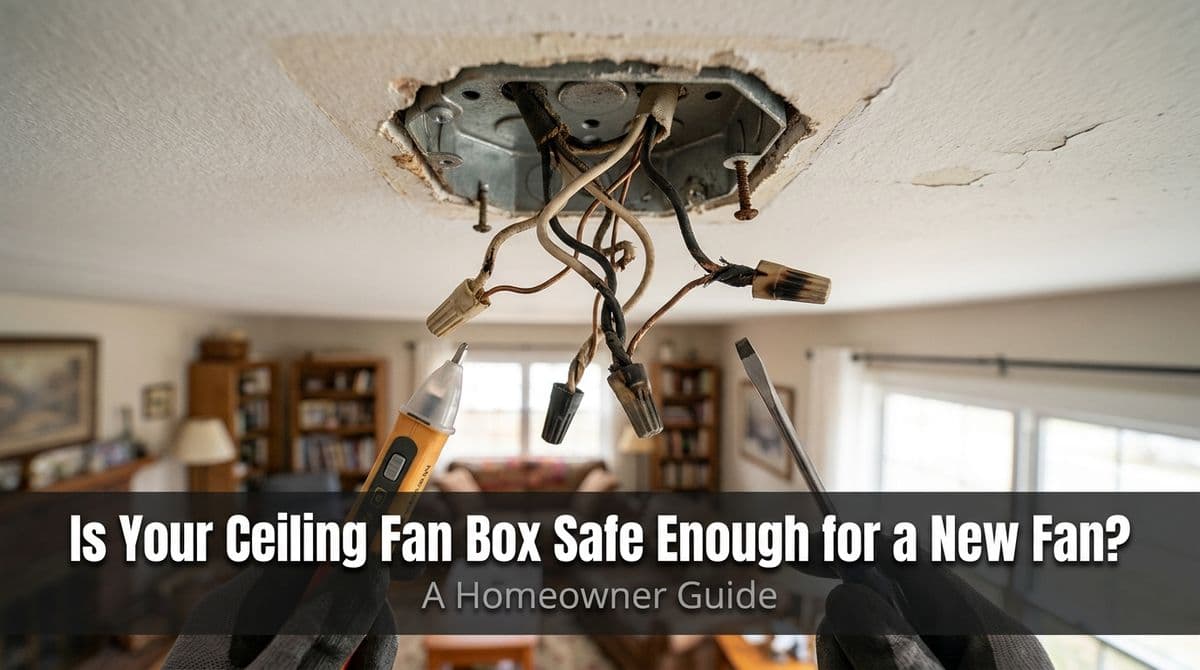
When a “Loose” Ceiling Box Stops a DIY Fan Install
We recently got a call from a homeowner — let’s call him Mark — who had taken down an old ceiling fan and was getting ready to install a new one. As he was up on the ladder, he grabbed the ceiling box and realized he could move it side to side. That did not feel right, so he set the fan down and picked up the phone.
Mark told us the fan had been installed about seven years earlier by another electrician, and the box was a metal one. It didn’t move up and down, but it definitely shifted left and right. He said, “I’ve always done my own fans, but this feels loose. I think somebody ought to check that before I hang a new one.” He was exactly right.
That call is a perfect example of why we always tell homeowners: before you hang a new fan, you need to make sure the ceiling fan box is actually rated and secure enough to hold it.
Ceiling Fan Box vs. Regular Junction Box
One of the first things we ask when someone calls about a fan install is, “What kind of box is up there?” Not all ceiling boxes are created equal.
Here’s the basic difference:
- Standard junction box: Designed to hold wire connections and maybe a light fixture. It is not designed for a heavy, moving load like a fan.
- Fan-rated ceiling box: Specifically built and listed to support a ceiling fan’s weight and motion. These usually have stronger mounting hardware and are attached more securely to framing.
Many fan-rated boxes will actually be marked as such. Look for wording like “For Use With Ceiling Fans”, “Fan Support”, or a weight rating that mentions fans. If there’s no marking at all, we treat that as a question mark and inspect further.
Warning Signs Your Existing Box May Be Unsafe
When Mark mentioned his metal box could move side to side, that was our cue that we needed to take a closer look in person. From calls like his, we see the same red flags over and over:
- Any movement at all: If you can wiggle the box with your hand, especially side to side, the attachment to the structure may be compromised.
- Wobble when the fan runs: If an existing fan makes the box or ceiling visibly flex, that’s not normal — the fan may be too heavy for the support.
- Age and unknown history: Older boxes (or ones installed by “who knows who”) may never have been fan-rated to begin with.
- Plastic boxes: Many plastic boxes are not fan-rated and can crack over time. Some are, but they have to be properly labeled and mounted.
- Not clearly fan-rated: If the box doesn’t say it’s rated for a fan, or the mounting screws are tiny or oddly spaced, we assume it’s not suitable until we verify.
Any of these signs are enough reason to pause your DIY project and evaluate before you hang a new fan.
Why a Secure Fan Box Matters for Safety and Code
We sometimes hear, “The old fan was up there for years, so the box must be fine.” Unfortunately, that’s not always true. A fan puts a constant, moving load on the box — it doesn’t just hang there like a light fixture. Over time, that movement can loosen screws, pull on weak mounts, or crack plastic.
A proper fan-rated box:
- Is listed and labeled for fan support
- Is securely fastened to framing or a rated fan brace
- Meets electrical code requirements for weight and support
If the box isn’t up to the job, you’re risking:
- The fan eventually pulling loose from the ceiling
- Electrical damage from stressed or damaged wiring
- Injury or property damage if the fan or box comes down
That’s why, when we install or replace a ceiling fan, we treat the support box as a safety-critical component, not an afterthought.
What We Check (and Replace) Before Hanging Your Fan
When we scheduled Mark, we explained our process so he knew exactly what to expect. Any time we’re called for a fan install — whether you’ve already taken the old one down or not — we start with the box and support.
Here’s what we typically do on site:
- Turn off power and remove the fixture: We confirm the circuit is off and take down any existing fan or light.
- Inspect the box type and markings: We look for fan-rating labels, material (metal or plastic), and the condition of the box.
- Check how it’s mounted: We verify whether the box is attached directly to a joist or to a proper fan brace, and that the screws are tight and correctly sized.
- Test for movement: We gently try to shift the box. Any looseness tells us we need to repair or replace the support.
- Upgrade when needed: If the box is not fan-rated, is damaged, or is loose, we replace it with a listed fan box or fan brace kit that’s appropriate for the location.
Only after we’re satisfied with the box do we assemble and hang the fan, make the electrical connections, balance the blades, and test all speeds.
DIY vs. Calling an Electrician: Where to Draw the Line
We know many homeowners are comfortable putting a fan together and even hanging it — Mark had done his own fans for years. But there are clear points where it’s smart to stop and call us (or another licensed electrician):
- The box moves in any direction when you touch it.
- You can’t tell whether the box is fan-rated.
- The ceiling is finished and you’re not sure how to access the framing without damaging drywall.
- The wiring looks questionable (brittle insulation, loose connections, multiple cables crammed into a tiny box).
- You’re not comfortable working on a ladder with power circuits, even if they’re turned off.
If everything is clearly marked, the box is rock-solid, and you understand how to safely shut off power and make connections, you may be able to handle a straightforward swap. But the moment you feel movement, uncertainty, or see anything that doesn’t look right, it’s time to bring in a pro.
That’s what Mark did when he felt his metal box sliding side to side — and it gave us the chance to make sure his new fan would be safe, secure, and code-compliant for years to come.